Eye wash stations: workplace duties and placement
When do South African workplaces need eye wash stations?
- Assess the exposure before choosing equipment. Chemical decanting, battery maintenance and laboratory work can create eye-splash risks. The employer should identify the substances, examine their safety data sheets and establish which workers could need immediate irrigation. The assessment should also identify body exposure that requires a safety shower.
South Africa’s Occupational Health and Safety Act establishes the workplace safety framework. General Safety Regulations address risk evaluation and emergency facilities. ANSI/ISEA Z358.1 provides a separate technical benchmark for equipment performance; its numerical specifications should not be described as South African legislation.
A practical assessment records where a splash could occur, which tasks create it and how an injured person would reach help. Reassess the installation after moving a dosing point, changing chemicals or adding a production line. A station that served the previous layout may no longer protect the new work area. The broader emergency eyewash and safety shower station concept covers several equipment types, each with a different purpose.
Where should eye wash stations be installed?
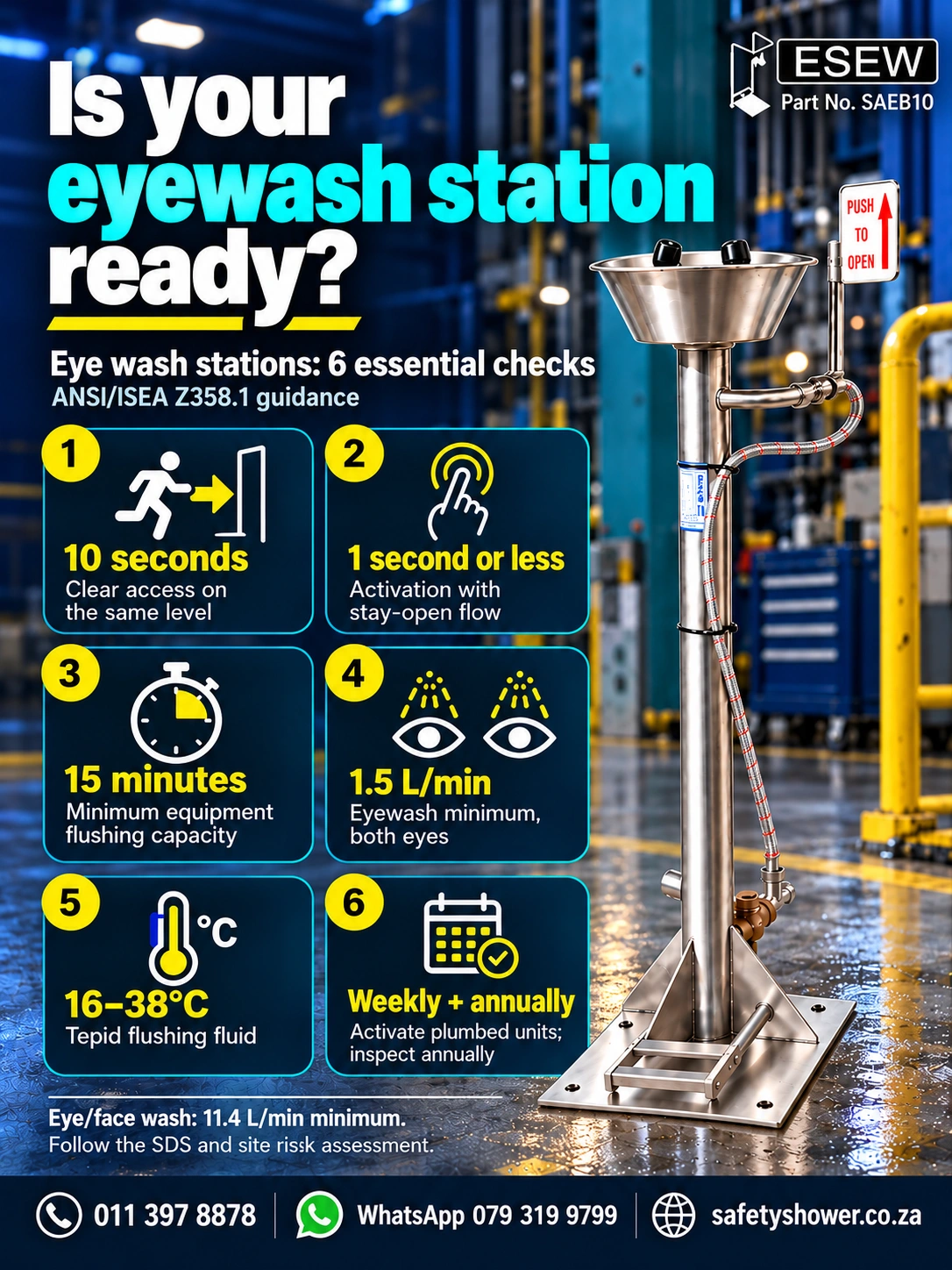
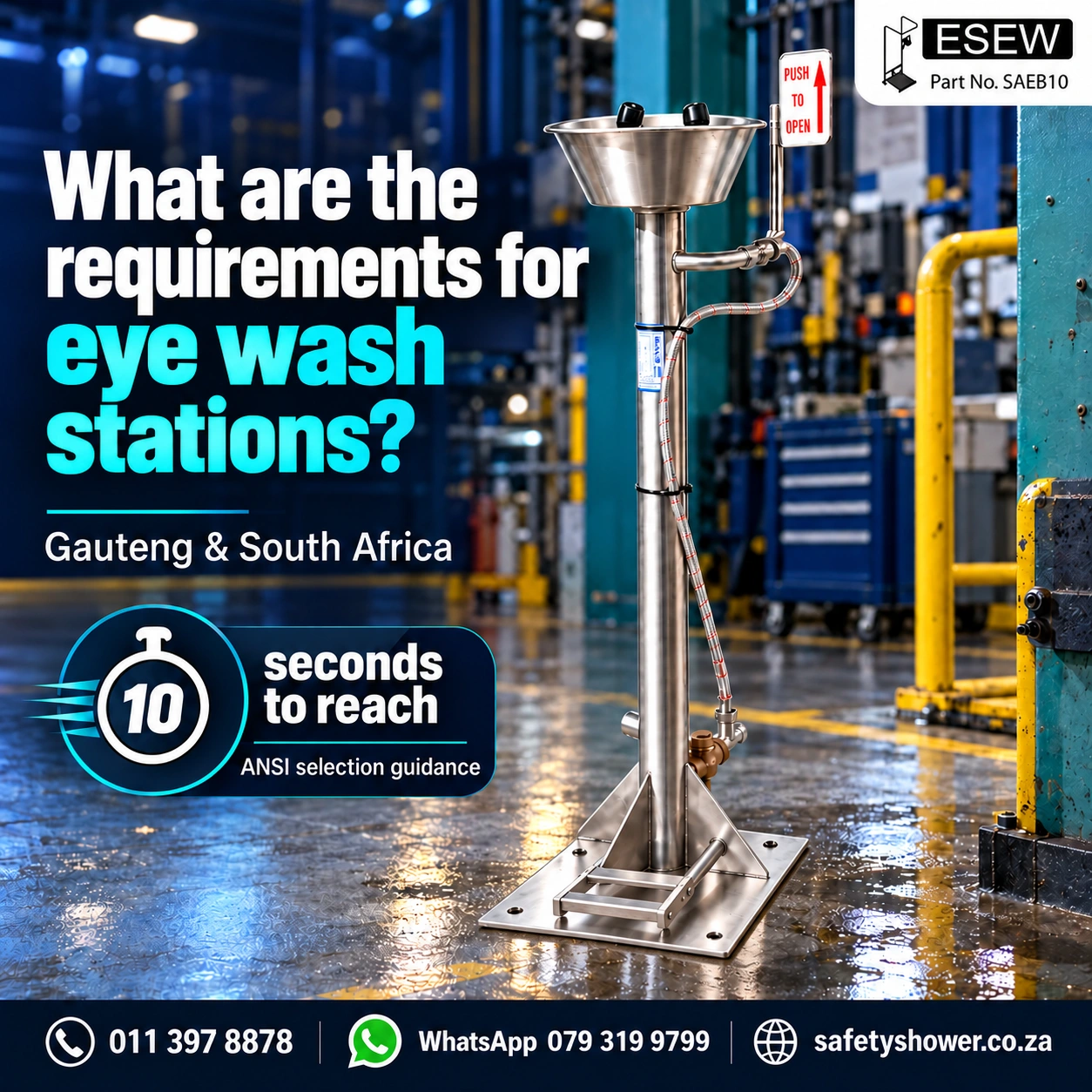
- Place the station within a clear 10-second travel route. ANSI guidance calls for equipment on the same level as the hazard, with visible signage and adequate lighting. Highly corrosive exposures can require immediately adjacent equipment. Base placement on the real route an injured worker must follow, rather than a floor-plan measurement.
A painted floor box cannot compensate for pallets, locked doors or machinery blocking access. Check the route during normal operations, including delivery periods, when temporary storage can narrow walkways. Workers may have impaired vision after a splash, so an easy route matters more than a convenient plumbing connection.
The installation needs space for the user to lean over the bowl and hold both eyelids open. Use the manufacturer’s dimensions and the relevant standard to verify spray height and clearance. Workshops and chemical-handling facilities across Gauteng’s industrial areas should check that changing stock levels leave the station accessible throughout the working day. CCOHS placement guidance explains why access must reflect emergency conditions.
Eye wash stations: flow requirements and system layout
How much water must eye wash stations deliver?
- An eyewash requires at least 1.5 litres per minute for 15 minutes. An eye/face wash requires at least 11.4 litres per minute for the same period. Both classifications need controlled, non-injurious flow. A larger bowl does not prove that a unit meets the higher eye/face wash specification.
| Equipment type | Minimum flow | Minimum supply duration | Intended coverage |
|---|---|---|---|
| Eyewash | 1.5 L/min | 15 minutes | Both eyes |
| Eye/face wash | 11.4 L/min | 15 minutes | Eyes and face |
| Emergency shower | 75.7 L/min | 15 minutes | Body |
At the stated eyewash minimum, 15 minutes uses approximately 22.5 litres. That calculation is a basic volume check, not a tank-sizing specification: usable capacity, the selected unit’s flow and installation losses still matter.
Test combination equipment with its shower and eyewash operating together. The common supply must maintain each component’s required performance. ISEA’s equipment selection guide explains the different classifications. Obtain documented performance information for the chosen model and verify it after installation, rather than relying on its appearance or part number.
How should the water system support eye wash stations?
- Provide tepid flushing fluid throughout operation. ANSI guidance defines a suitable range of approximately 16–38°C. Check the delivered temperature at the spray heads, including the first discharge. Outdoor pipework, stored water and seasonal conditions can change the temperature before anyone activates the equipment during an emergency.
The supply arrangement should maintain the manufacturer’s specified operating pressure without producing a forceful eye jet. Temperature control, backflow protection and pipe sizing need competent plumbing design suited to the actual installation. Include drainage or collection arrangements that manage discharged water without creating another workplace hazard.
The following layout shows the functional sequence, rather than a construction drawing:
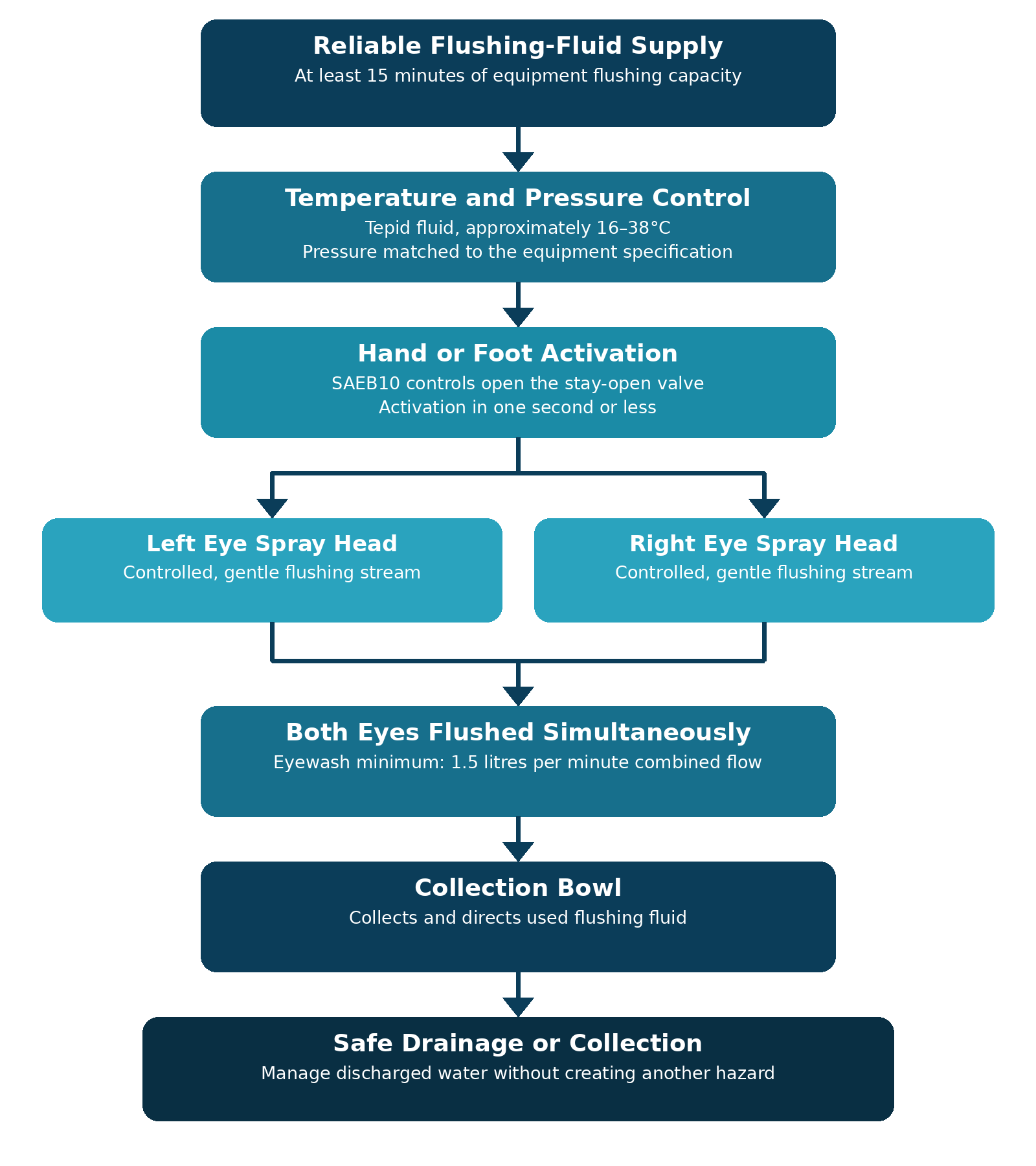
Dust covers should protect the outlets and release when the station operates, without a separate removal step. Haws’ ANSI checklist summarises temperature, activation and outlet-protection checks.
Eye wash stations: product selection and maintenance
Which eye wash stations suit the identified hazard?
- Select the equipment category before selecting the model. A dedicated eyewasher addresses eye irrigation. A shower-and-eyewash combination serves hazards that can affect the body and eyes. Personal eyewash bottles provide supplementary immediate flushing, but their limited supply does not replace equipment capable of a full 15-minute flush.
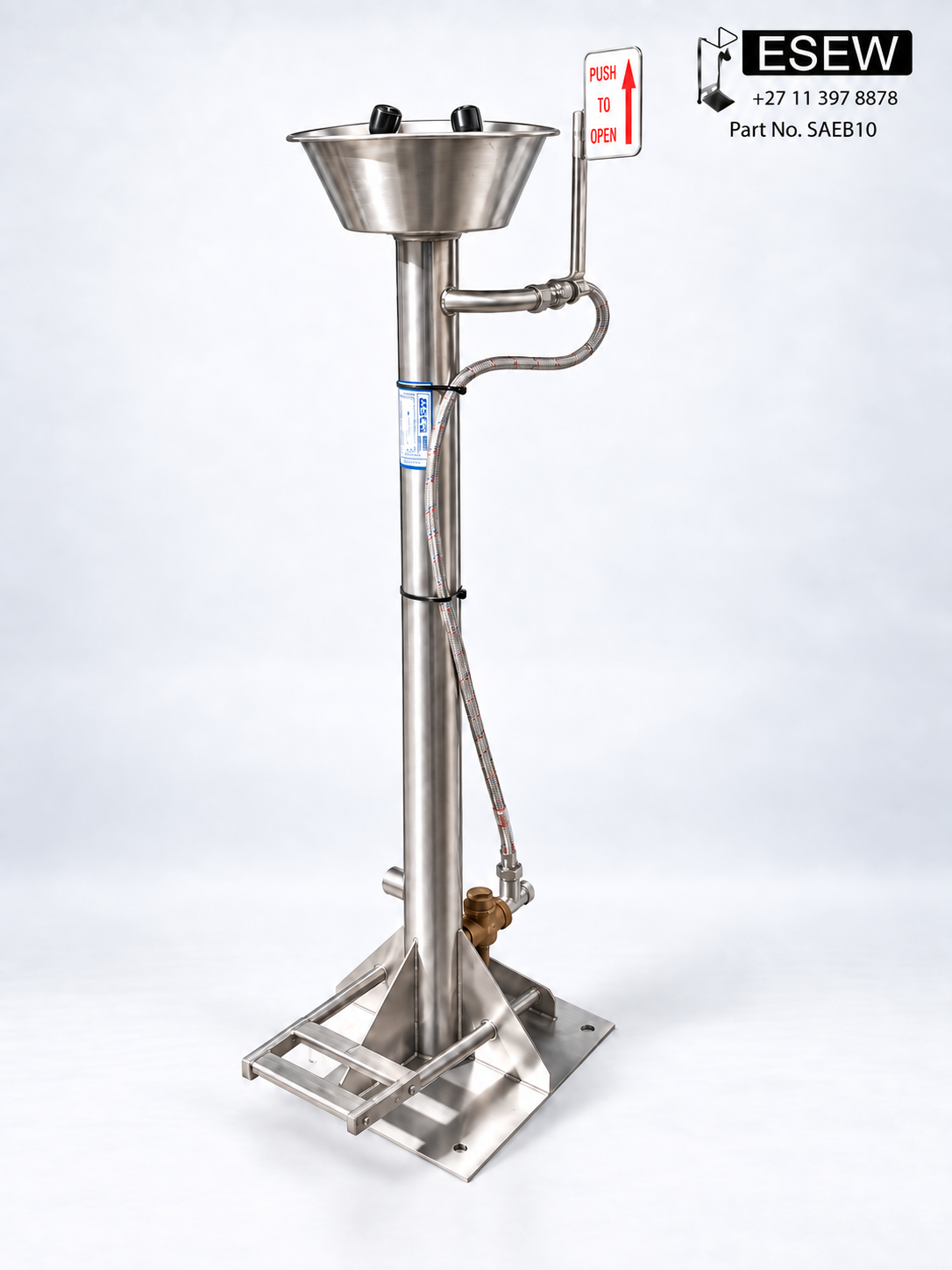
The SAEB10 Stand Alone Combo Operated Eyewasher provides a floor-mounted eye-washing point with hand and foot controls. Here, “combo operated” describes the controls; it does not mean the unit includes an overhead body shower.
For combined installations, compare the single column shower with optional eyewash bowls, four column booth with eyewash bowl and double column hand/foot operated combination. Confirm the bowl, controls, materials and water requirements in the quotation.
ESEW Shower and Stainless Steel offers stainless steel and other material options across its range. Confirm chemical compatibility for the complete assembly, including seals and fittings. A material label alone cannot establish whether a particular installation will remain serviceable in its chemical environment.
How often should eye wash stations be tested?
- Activate plumbed equipment weekly and inspect it annually. Weekly activation confirms fluid delivery and helps clear stagnant water and sediment. The annual inspection checks conformance with the applicable equipment standard. Self-contained units need visual checks and fluid maintenance according to their manufacturer’s instructions, including solution expiry and usable capacity.
Assign a named person to the checks and record the date, result and corrective action. Examine the controls, outlet protection, spray pattern, leaks, access and signage. A quick weekly activation does not replace the annual performance assessment. Bradley’s inspection guide separates these duties.
Train exposed workers to locate and activate the station before an incident. During a chemical splash, start irrigation immediately, follow the safety data sheet’s first-aid instructions and obtain urgent medical assistance. The equipment’s 15-minute capacity requirement does not set the maximum treatment duration for every chemical.
Stop hazardous work where the required station is unavailable until suitable protection is restored. Keep inspection records with the site’s emergency procedures so supervisors can confirm readiness.